

Check Engine Light Meaning: A Guide to Dashboard Warning Lights
Understanding the check engine light meaning is vital for vehicle performance. When an engine light illuminates on your vehicle’s dashboard, it’s your car’s way of communicating. From a loose gas cap to engine problems, we explain every check engine warning.
If you’ve ever been driving along a quiet road in Southern Ontario and suddenly seen a glowing amber or red icon pop up on your dashboard, you know that immediate sinking feeling in your stomach.
For many car owners, there’s nothing quite as unsettling as the check engine light. Because this specific warning light is linked to your vehicle’s onboard computer, the check engine light meaning can range from a simple loose gas cap to a serious problem within your exhaust system.
At Master Mechanic, we want to help you solve the mystery of the engine light. When your check engine light comes on, it’s your car telling you that something is wrong with the emissions system or vehicle performance.
We believe in providing honest advice you can act on, which is why we’ll walk you through exactly what your engine is trying to say.
What is the Check Engine Light?
The check engine light (formally known as the Malfunction Indicator Lamp) is a vital part of modern cars. It’s part of a complex system that monitors your engine’s health to ensure proper fuel efficiency and safety.
When the check engine light turned on, your car’s computer stored a specific trouble code. While some auto parts stores might offer to read this code for you, it’s just a starting point. It takes a professional mechanic to interpret that code and find the root cause, whether it’s a loose wire or a failing engine component.
How does the check engine light appear?
- Steady yellow check engine light: If you see a steady yellow check engine light, your car needs a service appointment soon. It isn’t an immediate emergency, but ignoring it can lead to poor fuel economy and a much more expensive fix down the road.
- Blinking Light or Flashing: A blinking light or flashing check engine light indicates an engine misfire. This is a serious problem that can cause your catalytic converter to overheat. If this happens, reduce your speed, pull over safely, and seek immediate assistance. You may even need to call for roadside assistance or a tow truck to avoid permanent engine damage.
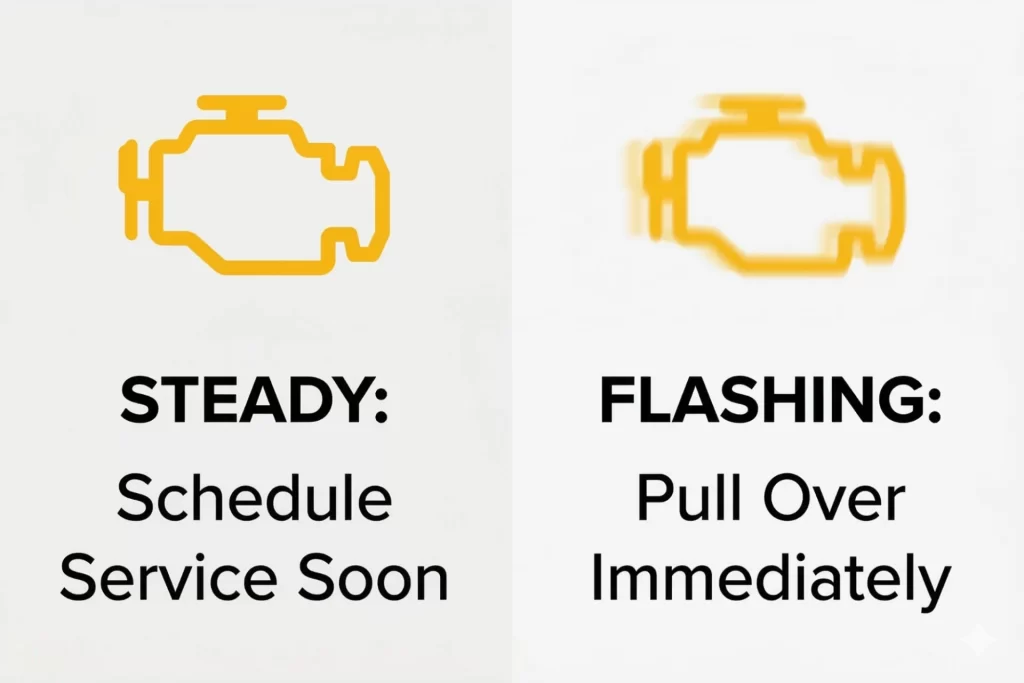
Image Source: Gemini 2026
Common Reasons Your Engine Light is On
Why does the check engine light appear in the first place? Here are the most common reasons our technicians see every day in our shops:
Check Engine Light
The check engine light’s meaning can vary wildly because it’s a “catch-all” for dozens of different issues. It might indicate:
- A loose gas cap (believe it or not, it’s one of the most frequent reasons the check engine light comes on) often triggers the engine light by failing to seal the gas tank.
- A faulty oxygen sensor causes poor fuel economy and reduced vehicle performance.
- A failing mass airflow sensor or worn spark plugs can cause stalling or an engine misfire.
Ignoring these smaller issues can eventually clog your catalytic converter, turning a simple repair into a much more expensive fix. Addressing these warning signs early ensures your vehicle remains dependable and safe.
| Check engine light symbol: An outline of an engine, usually yellow or amber. Urgency Level: Moderate (Yellow/Steady) to High (Flashing). What to do:
|
Oil Pressure Warning
This is one of the most important lights on your dashboard. It means your engine has lost oil pressure. Without proper oil pressure, your engine’s moving parts aren’t being lubricated, which can lead to total engine failure in minutes.
| Oil pressure warning symbol: An old-fashioned oil can with a drop dripping from the spout. Urgency level: Critical (Red) What to do:
|
Battery/Charging System Light
This light indicates that the vehicle’s charging system is not working correctly. Your car is currently running solely on the energy stored in the battery. Eventually, that battery will run out, and the car will stall.
| Battery/charging system light symbol: A rectangular battery symbol with plus (+) and minus (-) signs. Urgency Level: High (Red) What to do:
|
ABS (Anti-lock Braking System) Light
Your anti-lock brakes help you maintain steering control during a hard stop by preventing the wheels from locking up. When this light is on, the ABS system is deactivated.
| ABS light symbol: The letters “ABS” inside a circle. Urgency Level: Moderate (Yellow) What to do:
|
Image Source: Master Mechanic
Brake System Warning
This light can mean a few things:
- Your parking brake is still engaged
- Your brake fluid is dangerously low, or
- There is a serious problem with the brake hydraulic system.
| Brake system warning light symbol: A circle with an exclamation mark in the centre, or sometimes just the word “BRAKE.” Urgency Level: High to Critical (Red) What to do:
|
TPMS (Tire Pressure Monitoring System)
The tire pressure monitoring system light indicates that at least one of your tires is significantly under-inflated (or occasionally over-inflated). Driving on under-inflated tires reduces fuel efficiency, causes uneven tire wear, and can even lead to a blowout.
| TPMS light symbol: An exclamation mark inside a U-shape (which represents a tire cross-section). Urgency Level: Moderate (Yellow) What to do:
|
Engine Temperature Warning
When this light comes on, it means your engine is overheating. This is often caused by a leak in the cooling system, a failed thermostat, or a broken water pump.
| Engine temperature warning light symbol: A thermometer dipping into waves (representing coolant). Urgency Level: Critical (Red) What to do:
|
Traction Control/ESC Light
If this light flashes while you’re driving on a slippery road, it means the system is working to help you keep traction. However, if the light stays on constantly, there’s a fault in the system.
| Traction control/ESC light symbol: A car with two wavy lines underneath (skid marks). Urgency Level: Moderate (Yellow) What to do: Your car is safe to drive, but you won’t have traction control in slippery Ontario winters. Have a technician walk you through the diagnostic results during your next maintenance tune-up visit. |
Airbag Warning Light
This symbol coming on your car dashboard means there’s a fault in your vehicle’s Supplemental Restraint System (SRS). Your airbags may not deploy in an accident.
| Airbag warning light symbol: A seated passenger with a large circle (the airbag) in front of them. Urgency Level: High (Red) What to do: While the car will drive normally, your safety is at risk. This isn’t something to ignore; have it inspected immediately to ensure that everything that matters most is protected. |
Transmission Temperature Light
This symbol means your transmission fluid is too hot. It’s often due to heavy towing, low fluid levels, or excessive internal wear.
| What it looks like: A thermometer inside a gear or surrounded by brackets. Urgency Level: High (Yellow/Red) What to do: Pull over and let the vehicle idle in neutral or in park to allow the fluid to cool. Continuing to drive while this light is on can lead to a much more expensive repair, such as a total transmission rebuild. |
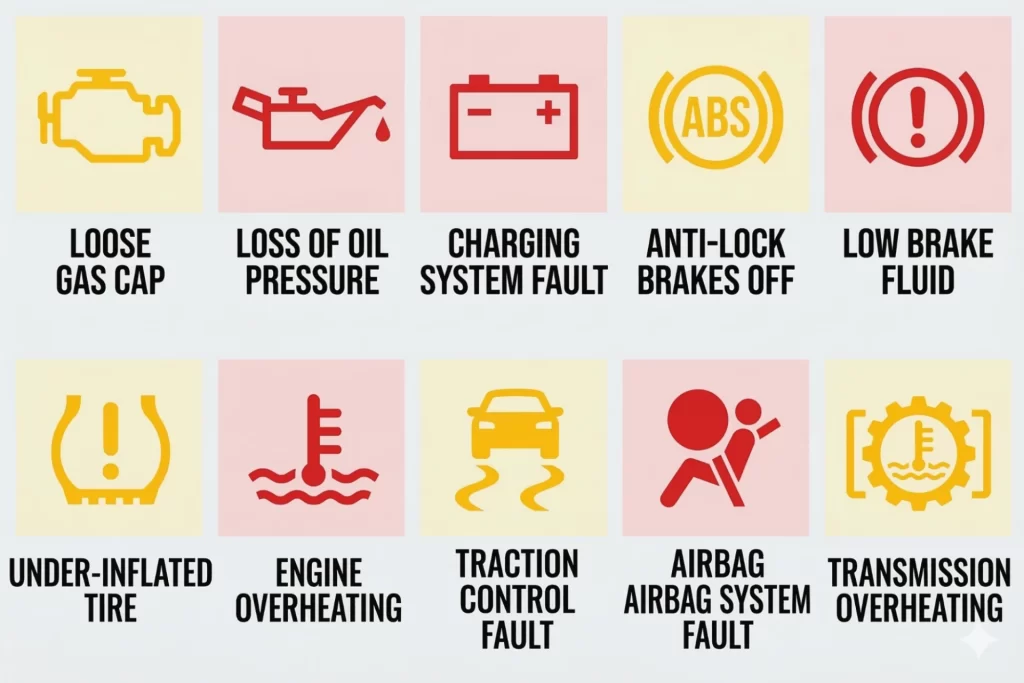
Image Source: Gemini 2026
FAQs About Warning Lights
If the engine light is steady, your car is usually safe for a short drive to a service centre. If it’s flashing, pull over immediately to prevent a serious problem, such as engine damage.
Yes, a loose gas cap is a common culprit. It disrupts the emissions system pressure. Try tightening the gas cap first; if the check engine light stays on, book a service appointment.
The check engine light’s meaning often involves invisible issues, such as a faulty oxygen sensor. Ignoring these can lead to poor fuel economy or a failing catalytic converter, turning a simple repair into a serious problem.
If the issue was a loose gas cap, it might reset after a few drives. However, most engine problems require a mechanic to scan the trouble code and provide a warranty-approved repair to reset the light.
Key Takeaways
- Decoding the check engine light’s meaning is the first step toward protecting your vehicle’s performance and the quiet confidence that everything’s under control.
- A flashing or blinking light indicates an engine misfire or other serious problem that requires you to pull over and seek immediate attention.
- Simple issues, such as a loose gas cap, are common triggers for a yellow check engine light and should be checked before booking a service appointment.
- At Master Mechanic, you talk to the mechanic directly to get honest advice and ensure your repair is warranty-approved.
Next Steps: When to Get Your Vehicle Checked
When your check engine light or any other warning light comes on, your first step should be to stay calm. Most modern cars are designed to give you enough warning to get to a service centre safely.
If the light is steady:
- Check your gas cap to ensure it’s tight.
- Monitor your vehicle performance for any changes in power or steering.
- Book a service appointment with your local mechanic to have the trouble code scanned.
At Master Mechanic, we pride ourselves on being a community-minded partner in your vehicle’s health. We don’t just provide a repair; we provide professional help and a plan you can trust.
Our technicians will explain the meaning of the check engine light in plain language so you can make the best decision for your car and your budget.
Don’t let a mystery light on your dashboard ruin your day.
Ready to get that light checked out? Come and book your appointment today at a Master Mechanic location near you and experience the community-rooted service your neighbours have trusted for over 40 years.